Not All Tints Are Equal: The Real Difference Between Dyed, Carbon & Ceramic Window Tint (And Why High-End Ceramic Is Worth Every Penny)
Here's the truth most tint shops won't tell you: the "tint" you pick matters more than the shade you pick. Two cars can roll out of two different shops with the exact same darkness — and one will be cool to the touch at noon while the other is a sauna you can't wait to escape.
The difference isn't the darkness. It's the technology inside the film. And in Huntington Beach, where the sun beats down 300+ days a year and cabin temperatures can hit 140°F in a parked car, that difference is not a luxury — it's comfort, health, and on an electric vehicle, actual driving range.
This is the honest, no-fluff breakdown of the three tint technologies on the market today, and why almost every customer who upgrades to high-end ceramic at Shineless tells us the same thing: *"I wish I'd done this sooner."*
The Three Types of Window Tint — And What Each One Actually Does
Every window film on the market falls into one of three technology buckets. The price gap between them isn't marketing — it's chemistry.
1. Dyed Window Film — The Cheap Option
Dyed film uses a layer of colored pigment to absorb solar energy. It's the most affordable tint on the market, and it looks fine on day one. But here's the catch: dye breaks down. UV radiation breaks apart the dye molecules the same way it fades your upholstery. Within 3–5 years, a dyed film can turn purple, bubble, and lose most of its heat-rejecting ability. It's a short-term fix that costs you more in the long run — because you'll be paying to peel it off and redo it.
2. Carbon Window Film — The Mid-Range Option
Carbon film uses carbon particles (instead of dye or metal) to absorb and reject solar heat. It's a genuine step up from dyed film: it won't fade, won't turn purple, and won't corrode — carbon is color-stable for the life of the film. It also rejects heat far better than dyed film and, importantly, contains no metal — so it doesn't interfere with GPS, Bluetooth, cellular, or keyless entry signals. The trade-off is that carbon rejects noticeably less infrared heat than high-end ceramic, and it darkens the glass more for the same heat rejection. It's the smart pick if you want a durable, signal-safe upgrade on a budget — but it won't deliver the "walk in and it's genuinely cool" cabin that ceramic does.
3. Nano-Ceramic Window Film — The Premium Option
Ceramic film uses microscopic, non-conductive, non-metallic ceramic particles suspended in the film matrix. It rejects heat at the infrared level — the actual wavelength that makes you feel hot — without any metal, any dye, and any signal interference. It doesn't fade, doesn't corrode, doesn't turn purple, and doesn't block your GPS or Bluetooth. It is the only film technology that performs on day one exactly the same way it'll perform in year ten.
Why High-End Ceramic Is the Only Real Upgrade
Here's where it gets important — because not all ceramic tint is created equal either. There's entry-level ceramic, and then there's high-end ceramic engineered for maximum thermal performance. The difference shows up in two numbers that actually matter:
Infrared (IR) Rejection — Infrared radiation is the heat you feel on your skin when sunlight hits you. It's not visible light — you can't see it — but it's responsible for the majority of the heat that builds up inside your car. High-end ceramic films reject up to 99% of infrared heat. Entry-level ceramic might reject 50–70%. That gap is the difference between a cabin that's merely "less hot" and a cabin that's genuinely cool to walk into.
Total Solar Energy Rejected (TSER) — TSER is the single most honest number in the window film industry. It measures the total percentage of solar energy — UV, visible light, and infrared combined — that the film blocks from entering your car. A high-end ceramic film can eliminate up to 70% of total solar heat (TSER). That means 70% of the heat that would have baked your interior never makes it through the glass.
What that feels like in real life: You walk back to your car parked in the Huntington Beach sun for three hours. With a cheap film, the steering wheel burns your hands, the seats are too hot to sit on, and the AC screams for 15 minutes before the cabin is livable. With high-end ceramic at 99% IR rejection and 70% TSER, the cabin is warm — not scorching. The AC brings it to comfortable in 2–3 minutes. You feel the difference drastically, the very first time you get in.
The EV Battery Factor — Why Ceramic Tint Literally Saves Range
If you drive a Tesla, a Rivian, a Mach-E, an Ioniq, or any EV — this section is the one that actually pays for your tint.
An EV's air conditioning system runs off the high-voltage battery. There is no engine waste heat to borrow. Every BTU of cooling your AC produces is range you're spending. On a hot Orange County afternoon, an EV parked in the sun can lose 10–20% of its usable range just running the AC to cool a 140°F cabin down to 75°F.
High-end ceramic tint changes that math completely:
- Up to 70% less solar heat enters the cabin — so the cabin starts cooler.
- The AC works a fraction as hard — pulling a fraction of the battery.
- You preserve real-world driving range — especially on road trips, school pickups, and daily commutes where every mile matters.
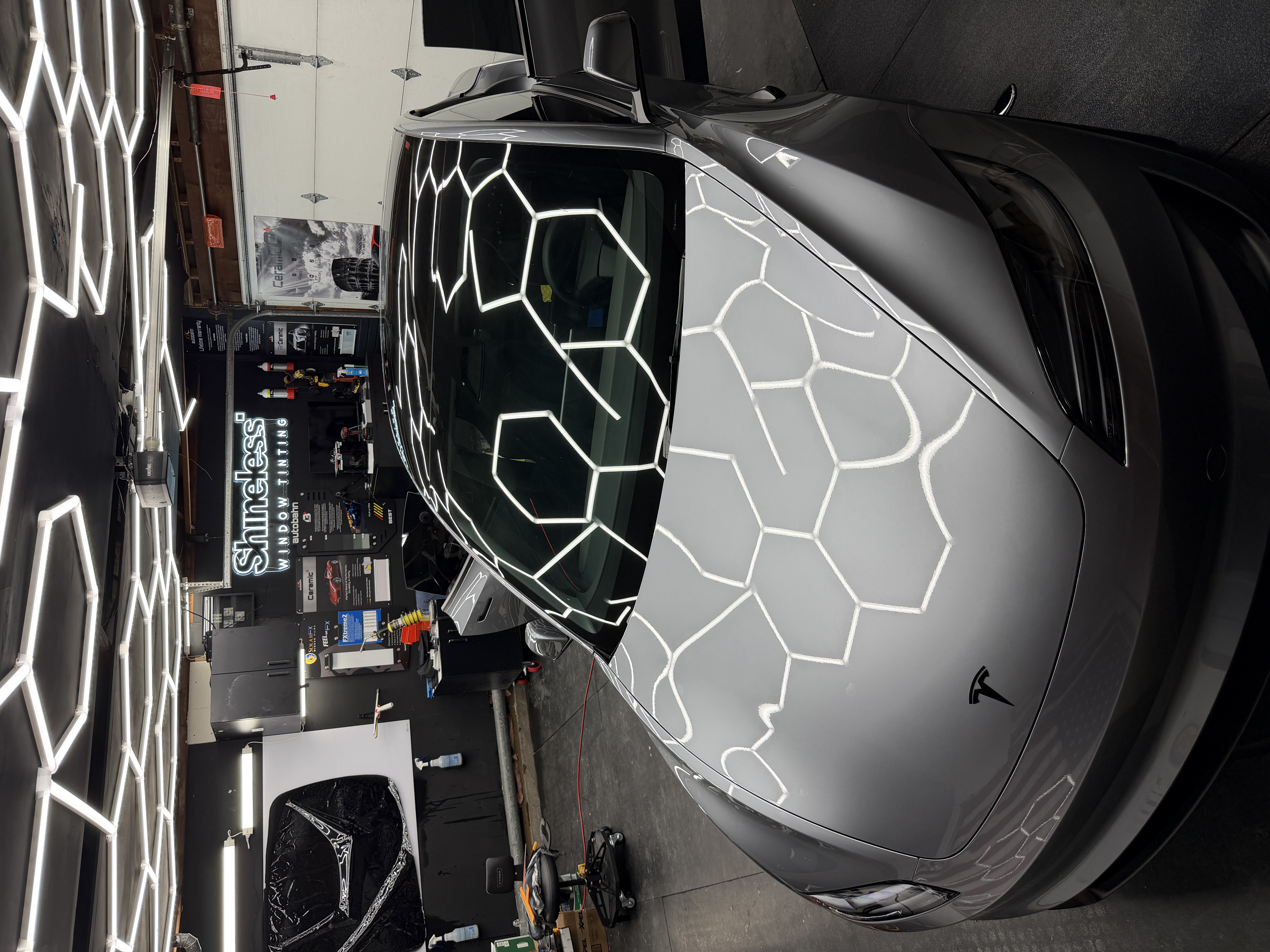
Tesla owners consistently tell us the same thing after a high-end ceramic install: the cabin stays cooler while parked, the AC reaches target temperature faster, and they notice measurably less range drain on hot days. On a Model 3 or Model Y with a panoramic glass roof, the difference is even more dramatic — that giant glass surface is a solar heat collector, and ceramic film is the only thing standing between it and your battery.
Think of high-end ceramic tint as a one-time investment that pays you back in range, every single day, for the life of the vehicle.
What You Actually Get With a Shineless Ceramic Install
Every ceramic installation at Shineless is built around one promise: it should feel like the best money you've spent on your car.
- Premium high-end ceramic film only — We don't carry entry-level ceramic. If you're upgrading, we want you to actually feel the difference.
- 99% IR rejection, up to 70% TSER — The numbers that translate to real comfort, not marketing.
- Zero signal interference — GPS, Bluetooth, cellular, keyless entry, and radar sensors all work exactly as the manufacturer intended.
- Plotter-cut or hand-cut precision — A factory-quality fit on every panel, every time.
- Same-day mobile service — We come to your home or office anywhere in Huntington Beach and Orange County. Most installs are done in under 3 hours.
- Lifetime warranty — Real, transferable, backed by the manufacturer. No bubbling, no peeling, no fading, no purple — ever.
- Flat, honest pricing — Any shade, same cost. You pick the look you want; we don't upcharge for going darker.
The Honest Risk of Going Cheap
We believe in being straight with you, so here's what actually happens when you go with the cheapest tint quote you can find:
- You'll redo it. Cheap dyed film bubbles, peels, and turns purple within 3–5 years. You'll pay twice — once for the cheap job, and again to have it scraped off and redone properly.
- You'll still be hot. A low-end film might darken your windows but reject only a fraction of the infrared heat. You'll look tinted — and still be sweating.
- You may damage signals. A metallic film on a modern car can degrade your GPS, Bluetooth, and even adaptive cruise control sensors. On a Tesla or any tech-heavy vehicle, this is a real, documented problem.
- Your EV battery works harder. Every degree hotter your cabin starts, the more battery your AC burns catching up. Cheap tint literally costs you range every day.
The math is simple: high-end ceramic costs more once, and pays you back every day for the life of the car. Cheap tint costs less once, and costs you again — in comfort, in range, and in a redo.
A Curiosity: What About Metallic (Reflective) Films?
You may have noticed we skipped a fourth technology — metallic, or metallized, window film. There's a good reason it's not part of the main comparison: for automotive use, highly reflective metallic films are largely illegal.
In California and most U.S. states, the law restricts mirror-like reflective films on vehicle windows — front side windows in particular must be non-reflective, and even rear windows have strict reflectivity limits. A true metallic film turns a car into a rolling mirror, which is dangerous (it blinds other drivers at night), illegal, and a magnet for fix-it tickets.
But metallic film isn't useless — it just belongs in the right vehicles. Here's where reflective films are actually still used and valued:
- Buses, vans, and commercial trucks — Fleet operators use reflective film for maximum heat rejection and privacy, where signal interference doesn't matter and the mirror look reads as "commercial."
- Showcase and show cars — On the car-show circuit, a mirror finish is a deliberate aesthetic statement. These vehicles aren't daily drivers, so the legal and signal trade-offs don't apply.
- Museum and collector cars — Restored or preserved vehicles in glass-walled showrooms use reflective film to keep interiors cool without running climate systems 24/7.
- Aerospace and specialty vehicles — Metallic films have a long history in aviation and aerospace, where reflective coatings manage extreme thermal loads on canopies, windows, and instrument panels — the same principle that keeps a satellite cool in orbit.
- Armored and tactical vehicles — Reflective film adds a layer of heat management and visual privacy to security vehicles.
The interesting part: metallic film works by physically reflecting solar energy away (like a mirror), whereas ceramic film absorbs and blocks it at the infrared level without any reflection. That's why ceramic gives you the heat rejection of a metallic film with none of the legal, signal, or aesthetic downsides — and why it's the only technology we install on personal vehicles at Shineless.
Ready to Actually Feel the Difference?
If you're in Huntington Beach, Newport Beach, Costa Mesa, Irvine, or anywhere in Orange County, the fastest way to understand the difference is to experience it. Call or text us at (714) 360-9969 — we'll bring film samples, walk you through the options, and give you a flat, honest quote with zero pressure.
Want to see real installs and thermal comparisons before you decide? Check out our Instagram and YouTube — we post educational videos, before-and-after heat tests, and full install walkthroughs so you can see exactly what high-end ceramic does before you spend a dollar.
Shineless is a Certified Hüper Optik Dealer
We are authorized to install and warranty the complete Hüper Optik product line — every series, every VLT, every option. Explore Hüper Optik at huperoptikusa.com →
Ready to Protect Your Home?
Free in-home consultations across Huntington Beach, Newport Beach, Seal Beach & Laguna Beach.
(714) 360-9969 — Free EstimateSee Real Installs & Heat Tests
Watch full ceramic tint installs, before-and-after thermal comparisons, and educational breakdowns on our channels.
Stop UV Damage Before It Starts
Shineless installs premium ceramic window film at your home — no shop visit needed. Serving Huntington Beach, Newport Beach, Seal Beach, Laguna Beach, and all of Orange County.