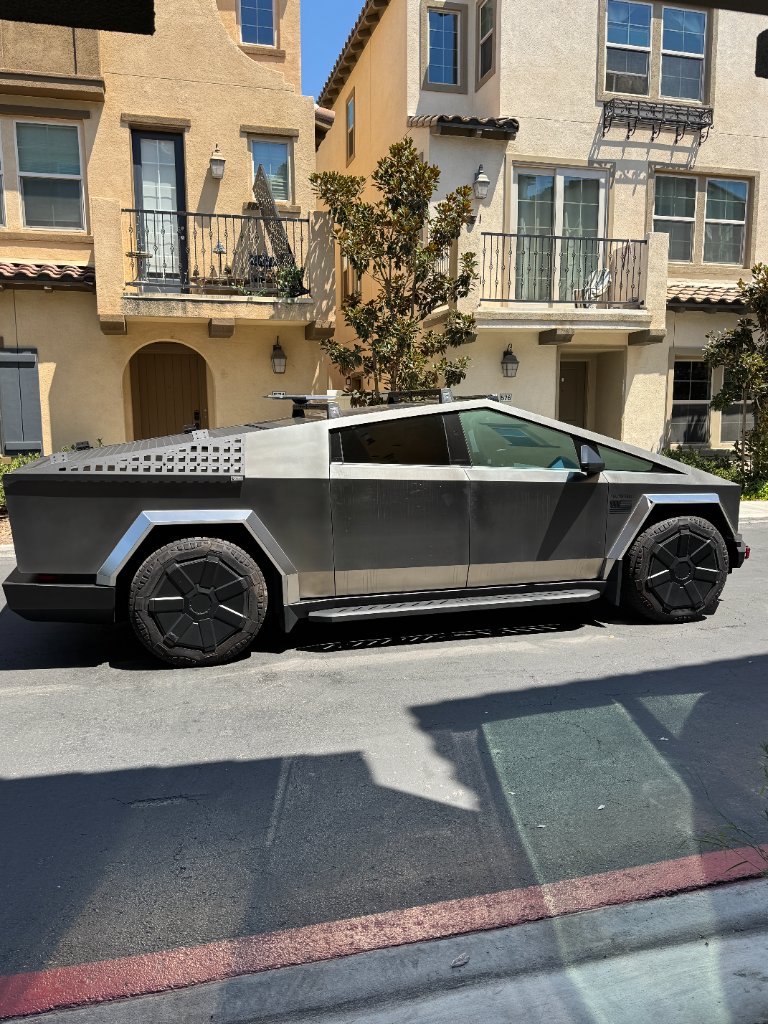
Your EV Is Paying for the Sun Out of Its Battery: How Heat, A/C, Heaters & Cabin Overheat Protection Drain Your Range Every Single Day
You already know the feeling. You parked with 210 miles of range. Two hours later the screen says 196. You didn't drive anywhere — the sun did.
That's not a glitch, and it isn't a rounding error. In an electric car, heat is a line item on your battery, and every part of the car that fights it — the air conditioning, the heater, the battery's thermal management, even the system that protects your cabin while you're parked — draws power from the exact same pack that moves you down the road.
Here's the part most EV owners don't find out until someone tells them: the biggest solar load your car faces doesn't come through the roof or the doors. It comes through the glass. And that is something you can actually fix.
Why Heat Costs an EV Far More Than It Costs a Gas Car
In a gas car, climate control is nearly free. The engine is already producing enormous amounts of waste heat, the A/C compressor is spun by a belt off an engine that's burning fuel anyway, and the range penalty for blasting cold air is barely worth measuring.
An electric car has none of that slack. There is no engine heat to borrow, no belt-driven accessory, no fuel being burned whether you use it or not. Every thermal job is an electrical job:
- Cooling the cabin — an electric A/C compressor typically draws somewhere between 2 and 5 kilowatts while it's working hard.
- Heating the cabin — in winter, a resistive heater can pull 3 to 6 kilowatts. A heat pump is dramatically more efficient, but it still takes real energy, and it loses effectiveness in the cold.
- Managing the battery — pumps, fans, and the pack's cooling loop run in extreme heat, sometimes while the car is parked and switched off.
- Protecting the cabin while parked — many EVs (Tesla's Cabin Overheat Protection being the best known) will run the A/C on an empty car to keep the interior from cooking.
On a gas car, that list costs pocket change. On an EV, it comes straight out of your range — and independent testing backs it up. AAA's climate testing found EV range dropping roughly 17% at 95°F with the A/C running, and far more in the cold: with the heater on at 20°F, range fell around 40%.
On a 300-mile EV, that's a huge slice of your car's capability disappearing into the air — before you've driven a single mile.
What's Actually Draining Your Battery When It's Hot
Break it down and it's easy to see where the energy goes on a normal Huntington Beach afternoon:
The A/C compressor does the heavy lifting. Pulling a 140°F+ cabin down to something comfortable is minutes of hard compressor work. If your A/C draws 4 kW for the first 20 minutes of a commute, that's about 1.3 kWh gone — roughly 4 miles of range, spent before you leave the neighborhood.
Cabin Overheat Protection runs while you're not even there. Leaving the car parked in the sun with overheat protection on means your car is burning charge to cool an empty cabin. Many owners report losing several percent of charge a day this way. On a standard 120-volt outlet, it is genuinely possible for the car to spend more energy cooling itself than the outlet is putting back in — you plug in, and the range goes down.
Battery thermal management kicks in when it's extreme. In serious heat, the pack's cooling system runs pumps and fans to protect the cells, parked or not.
Solar gain through the glass builds the whole problem in the first place. Glass is a greenhouse. Sunlight pours in, heats the seats, dash, and carpet, and that heat has nowhere to go. The A/C's first job is removing heat that entered through the windows — the very heat a good film rejects before it ever gets inside.
And in winter, the heater is the A/C's evil twin. Heating is the single biggest cold-weather range thief on the road. Same principle, opposite season, same battery paying for it.
The Math: What the Heat Is Actually Taking From You
Let's keep it honest and simple. A typical EV uses roughly 3 miles per kWh of usable energy.
- A/C, 30 minutes of hard work: about 2 kWh consumed → roughly 6 miles of range you never drove.
- Parked in the sun all afternoon with overheat protection: commonly a few percent of charge a day. Park outside five days a week and that's real range, every week.
- Hot-weather A/C total impact: independent testing consistently lands around 15–25% of range in serious heat — and up to 40% in freezing temperatures with the heater running.
Stack that over a year of Orange County summers and coastal winters and you're talking about a meaningful amount of electricity and thousands of miles of usable range quietly spent on climate control — because a car with a lot of glass and no heat rejection has to fight the sun with its most expensive asset.
And that's the short-term bill. The long-term one is worse.
The Long-Term Bill: Heat Is What Ages Your Battery
Range loss on a hot day is annoying. Battery degradation is expensive.
Lithium-ion chemistry is sensitive to temperature, and battery research points to a consistent pattern: capacity fade accelerates as temperature climbs, with the aging rate getting worse for every 10°C (18°F) increase above roughly 25°C (77°F). Packs that live in a hot, sun-baked environment age faster than packs that live in a shaded garage.
Your EV protects itself — it has a thermal management system precisely because heat is the enemy — and one hot afternoon isn't what kills a battery. It's the daily pattern: a dark car, parked outside, on a west-facing driveway, in direct sun, all summer, with a cabin that regularly touches 140–160°F. That's years of cumulative thermal stress you're accepting by default.
You can't tint your battery. But you can stop your windows from turning your car into an oven in the first place.
What the Sun Is Doing to an Untinted EV Right Now
Be straight with yourself about what an untinted EV goes through on a normal sunny day in Huntington Beach:
- It pays to sit still. A parked EV in the sun is not dormant. Cabin overheat protection, screens, and thermal management quietly spend charge to survive the heat.
- It pays twice when you drive. The A/C has to remove the heat that built up inside the cabin *and* the heat the glass keeps pumping in while you're moving. More compressor load, more range gone.
- It cooks its own interior. Dashboards, screens, leather, and trim all bake. Surfaces near big glass fade, dry out, and crack years early.
- It ages the pack faster than it should. Daily heat exposure speeds the capacity loss that eventually shows up as permanently shorter range.
None of this makes a sound. Nothing lights up on the dashboard. The sun never sends you a bill. It just quietly takes it out of your car — in range today, in battery life down the road, and in resale value when the next owner asks how far it still goes on a charge.
If you drive an EV with big glass, no tint, and no shade, you are paying for the sun out of your battery — every day, whether you notice it or not.
Real EVs We've Protected Across Orange County
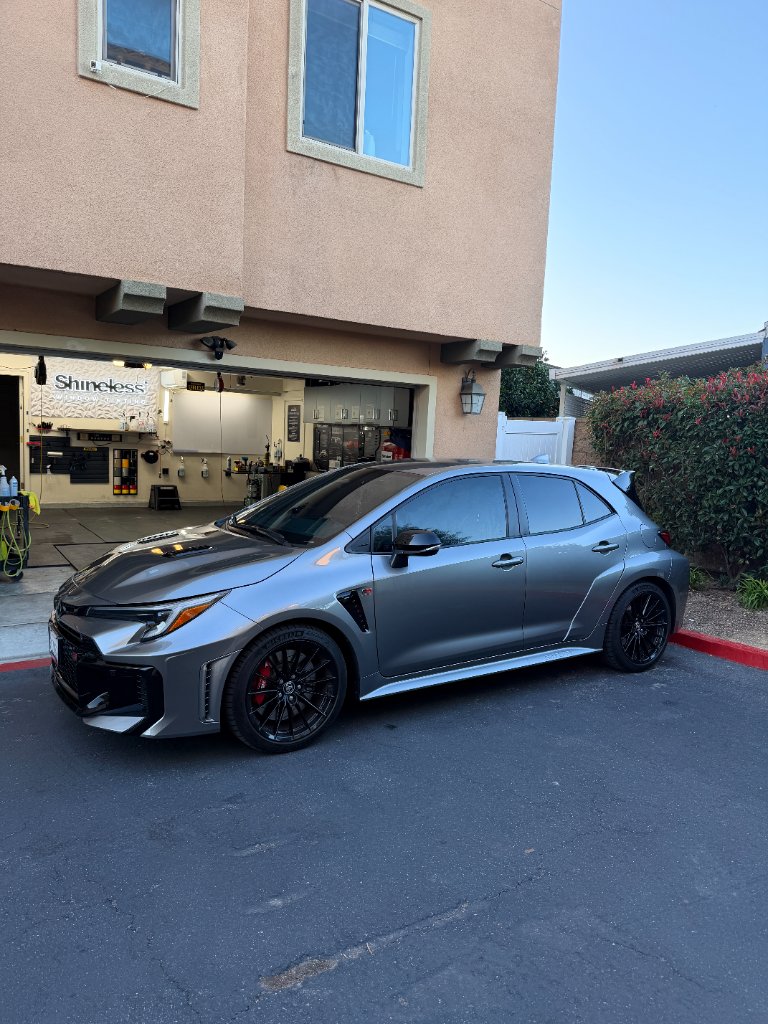
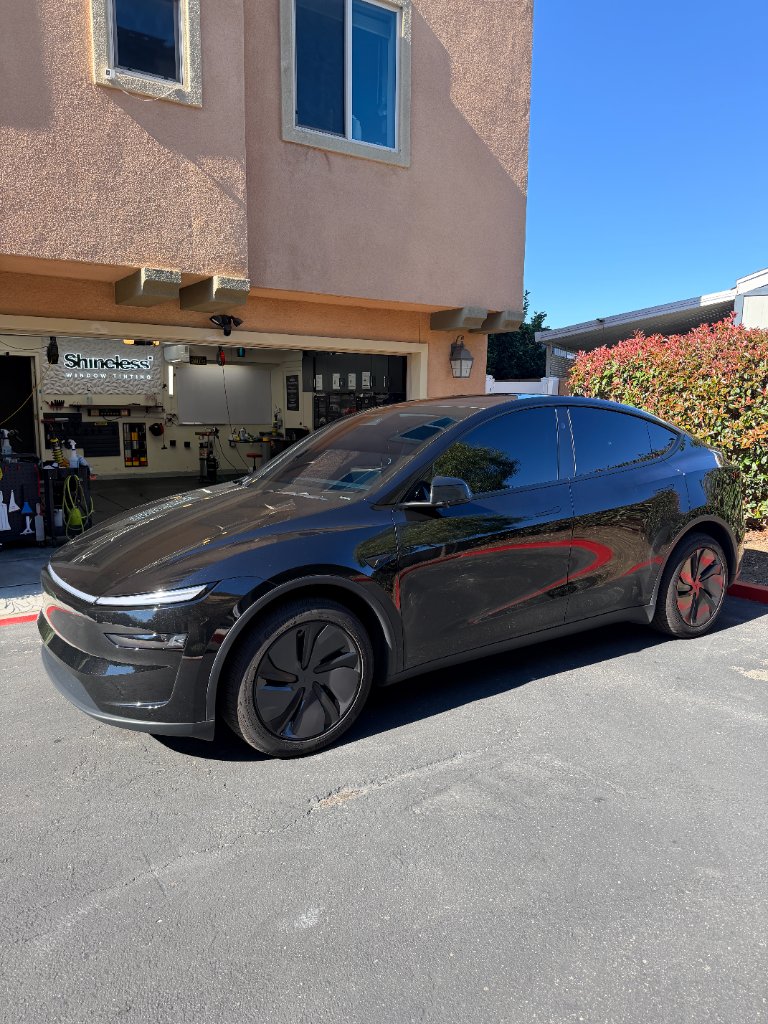
We tint every kind of electric vehicle that shows up in Huntington Beach — Teslas, Taycans, e-trons, Lyriqs, EV9s — and the difference in cabin temperature after a summer install is something owners notice on the drive home. These are real Shineless installs on real EVs:
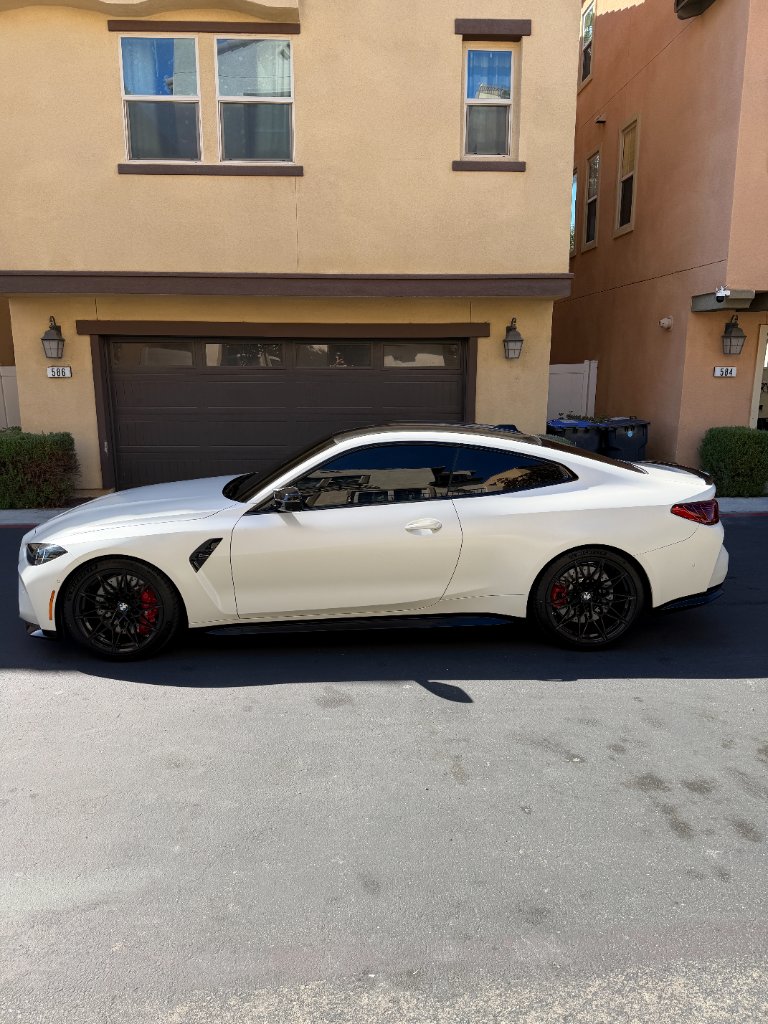
Tesla Model Y
Full nano-ceramic tint — Huntington Beach mobile install

Tesla Model S
Ceramic tint with zero signal interference — mobile service
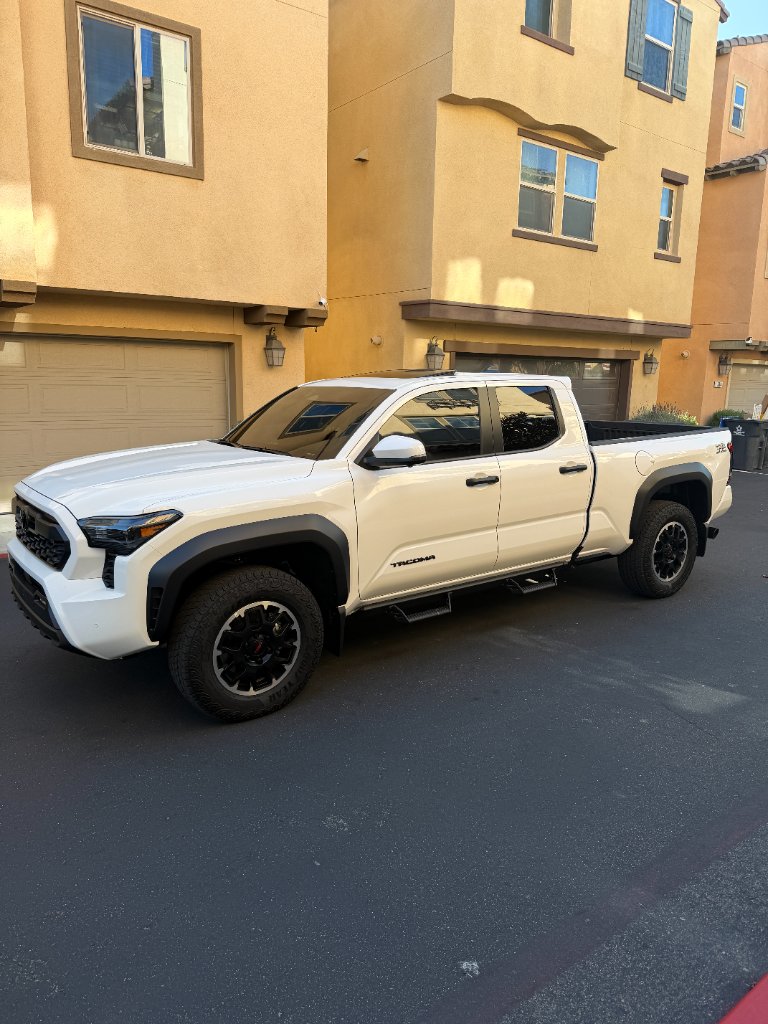
Audi e-tron
Complete ceramic package — Orange County driveway install
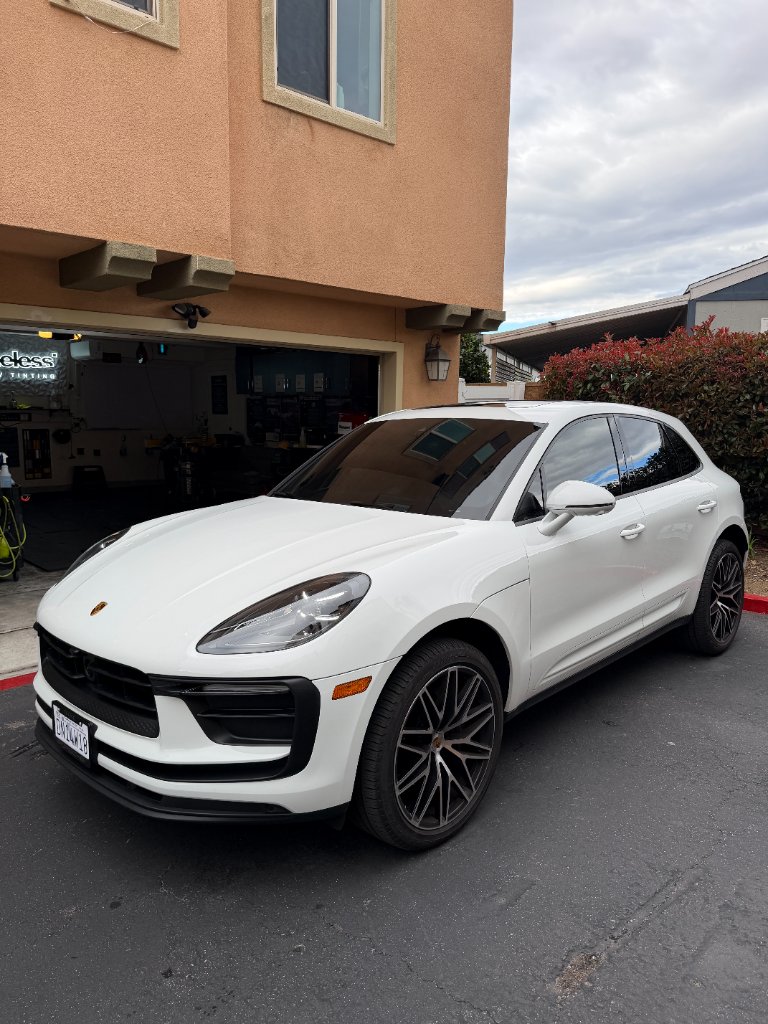
Audi Q8 e-tron
Full ceramic tint package on a big-glass EV
Cadillac Lyriq EV
Ceramic window film — glare and heat cut at the glass
Kia EV9
Three-row EV — full ceramic package, family-ready comfort
How Ceramic Window Film Changes the Math at the Source
Standard tint just darkens glass. Ceramic film rejects the heat itself — and on an EV, that difference shows up on your range estimate.
The premium nano-ceramic films we install reject up to 99% of infrared heat and up to 70% of total solar energy (TSER) before it ever enters the cabin. In practice that means:
- The A/C has less work to do. Less heat inside the cabin means the compressor runs shorter and less often — the exact load that eats range.
- The cabin doesn't soak. With the heat load cut at the glass, a parked EV stays meaningfully cooler, so overheat protection has less to fight and less reason to run.
- The interior is protected. Up to 99% UV rejection protects the dash, screens, seats, and trim from the fading and drying the sun does to an untinted car.
- Signals stay intact. This matters enormously on an EV. No metal in the film means no interference with GPS, cellular, Wi-Fi, OTA updates, phone-as-key, or driver-assist sensors — all things cheap metallic films are known to disrupt on modern connected vehicles.
That's the whole point: you're not buying shade. You're lowering the thermal load your battery has to pay for — every time you drive, and every time you park.
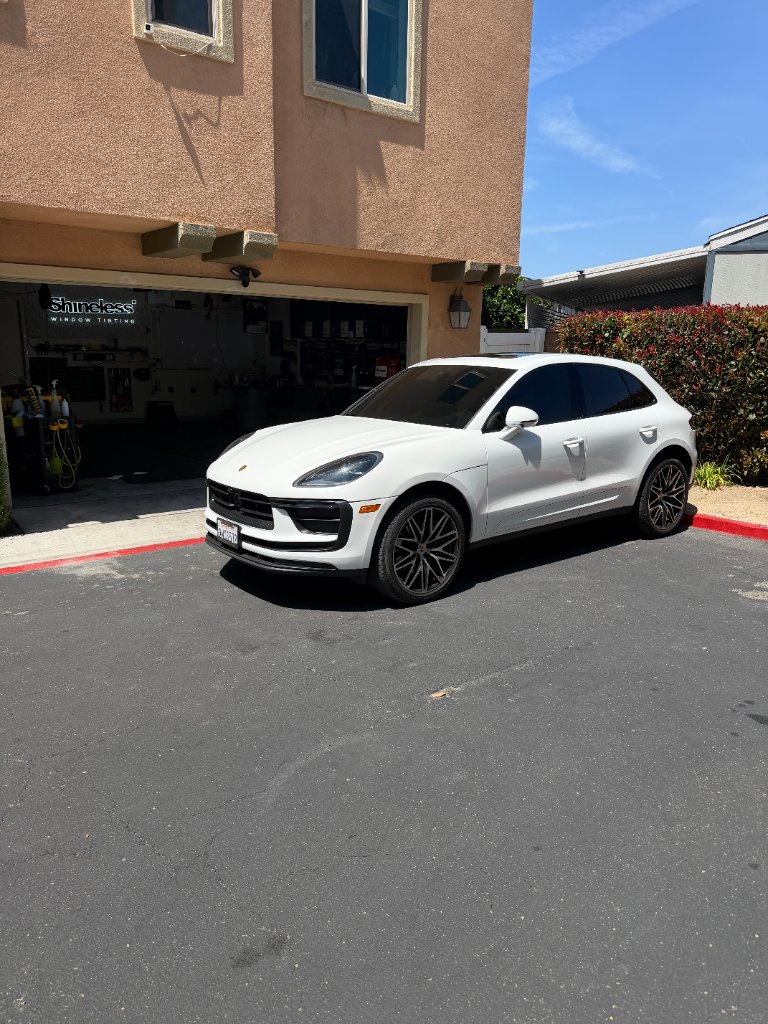
Porsche Taycan Turbo
Full ceramic package — bronze wheels, tinted glass, and a cabin that stops fighting the sun.
Winter Matters Too: The Heater Is the Bigger Thief
Everyone thinks about summer tint. In an EV, the bigger range story is often the heater — and glass is how the heat escapes.
In cold weather, heating the cabin is one of the largest single energy draws your car has, which makes anything that reduces how hard the heater works worth real range. Ceramic film's low-e characteristics reduce some of the radiant heat that would otherwise escape back out through the glass — a smaller effect than the summer heat rejection, and no substitute for a heat pump, but it works in your favor instead of against you.
Meanwhile the summer benefit is the big one: less solar heat in the cabin means less A/C load on the days that, in Orange County, vastly outnumber the cold ones.
One install, working for you in every season.
Honest Expectations: What Tint Will and Won't Do
We'd rather you make this decision with the full picture:
- Film will not eliminate A/C or heating use. It reduces the load they work against, which reduces the energy they spend. Anyone promising you "20 extra miles of range" from tint alone is selling you something.
- Film does not cool your battery pack. Your pack is managed by the car's own thermal system. What film changes is the cabin heat load — the part you actually control.
- Results vary by vehicle, glass type, how much glass your car has, the film selected, and where you park. A car with a panoramic roof parked outside in full sun sees the biggest difference.
- Legal limits are real. California requires a minimum of 70% light transmittance (VLT) on the front side windows and windshield. We will not install illegal shade on your car — period.
- Cheap film is a false economy. Dyed film fades, bubbles, and fails within 3–5 years, and metallic film can interfere with the signals your EV depends on. Both end up costing more than doing it right once.
And if you park in a shaded garage and rarely leave your car in the sun, your benefit is smaller — we'll tell you that honestly instead of selling you a package you don't need.
The Bottom Line: Tint Is the Cheapest Battery Insurance You Can Buy
You can't change how much sun Orange County gets. You can change how much of it your car has to absorb.
For the cost of one installation — backed by a lifetime warranty, completed at your home or office in 3 hours or less, with zero signal interference — you cut the biggest uncontrolled heat load your EV faces, reduce how hard the A/C and heater have to work, protect your interior, and stop paying for the sun out of the pack you'll be relying on for the next decade.
Shineless Window Tinting has been protecting Orange County vehicles since 2016, and we're fully mobile — we come to you anywhere in Huntington Beach, Newport Beach, Costa Mesa, Irvine, or across the county.
Call or text (714) 360-9969 or (424) 399-0506 for a free estimate, or book online and get it done this week. Your range estimate will thank you.
Ready to Protect Your Home?
Free in-home consultations across Huntington Beach, Newport Beach, Seal Beach & Laguna Beach.
(714) 360-9969 — Free EstimateSee Real Installs & Heat Tests
Watch full ceramic tint installs, before-and-after thermal comparisons, and educational breakdowns on our channels.
Stop UV Damage Before It Starts
Shineless installs premium ceramic window film at your home — no shop visit needed. Serving Huntington Beach, Newport Beach, Seal Beach, Laguna Beach, and all of Orange County.